Recently my wife and I stood among the Callanish Standing Stones on the Isle of Lewis in Scotland. These stones are five thousand years old, raised around 3000 BC, roughly two thousand years before the birth of Christ. They were already standing when the Egyptians began building the pyramids, more than three thousand years before Viking longships crossed the North Atlantic, nearly three thousand years before Julius Caesar was born, nearly four thousand years before Scotland became a nation. The context is almost impossible to comprehend.
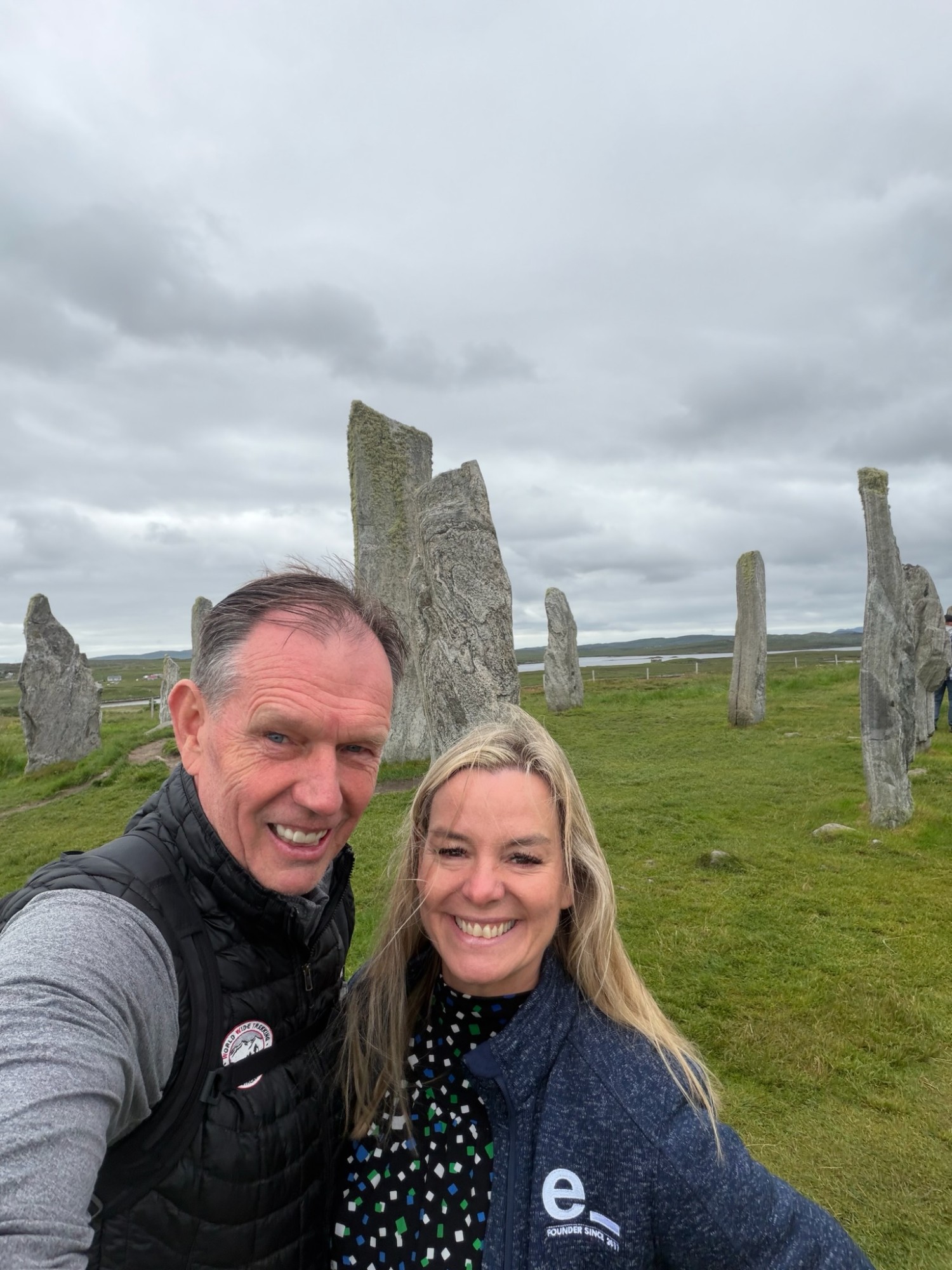
As I stood among them, looking across the rolling hills, the peat covered earth, the sheep grazing peacefully, and the rugged landscape stretching into the distance, I wasn’t overwhelmed by the stones themselves. I was overwhelmed by the people. Whoever they were, they invested extraordinary effort to move these massive stones, transport them across the countryside, and arrange them in a way that has endured for five millennia. Why remains something we don’t know with certainty. Perhaps they marked the heavens. Perhaps they honored their ancestors. Perhaps they gathered to celebrate, to mourn, to worship, or to give thanks. But one thing felt unmistakably clear. This place mattered, and you can almost feel it.
There is a serenity here that is difficult to describe, a quiet, a grounding, a peacefulness that settles over the landscape. I’ve felt something similar only a handful of times in my life, standing among the temples of Angkor Wat or dancing and hunting with the Hadza in Tanzania. Certain places seem to carry the echoes of those who came before us, and whether we can explain that feeling is almost beside the point.
As I reflected on the people who built these monuments, I found myself filled with respect rather than judgment. They were doing exactly what we continue to do today. They were reaching upward, trying to understand something greater than themselves, seeking meaning, purpose, and connection with the divine using the light they had been given. Knowledge builds over generations, but it should never require us to dishonor those who came before.
In recent years, I’ve begun a simple practice whenever I visit places that feel sacred. I quietly move through a round of Qigong. I reach toward heaven in gratitude for inspiration, then bring my hands back to my heart in thanks to God. I extend love outward to humanity and receive it back. I stand tall, then contract inward, remembering that life requires both expansion and reflection. Finally, I release my hands to the earth in gratitude for the ground that supports us before once again reaching upward.
Perhaps that is why places like Callanish move me so deeply. They remind me that every generation has built its own monuments, symbols, gathering places, and sacred spaces, not because stone itself is sacred, but because human beings need touchstones that remind us to look beyond ourselves. We don’t need to know exactly what happened here to recognize that this was a special place. Sometimes reverence speaks more clearly than certainty.
So here is the question worth carrying home from a hillside in the Outer Hebrides. Five thousand years from now, what will still be standing from your life? Not your house, not your accounts, not the things that felt urgent this week. The builders of Callanish left no explanation, only evidence that they cared about something larger than their own moment. The real question isn’t what they built. It’s whether you’re building anything at all.
Let’s keep building and let’s keep mystery alive,
Rich Christiansen
How To Set Boundaries With Adult Children and Grandkids (Without Pushing Them Away): Ep 14 | Calm the Chaos with Rich Christiansen
Two of our grandkids smeared chocolate cookies across the playroom walls and carpet, and it took my wife and me six hours to clean it up. Instead of getting harsh with my kids, I turned it into a playful new house rule, and it worked. In this episode I share the funny side of adult kids who drop by unannounced, the lonely side of boundaries set so tight the kids stop coming, and my three tips for setting boundaries with love. Watch Here.